
Orange “MiningTech Africa” text in a casual, handwritten style on a transparent background.
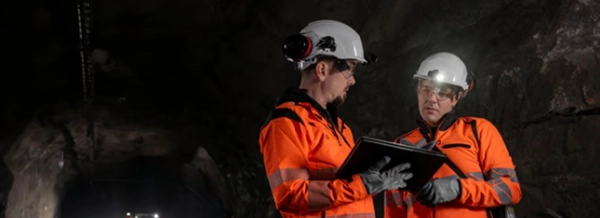
Two workers in orange safety gear and helmets review a clipboard inside a dimly lit underground tunnel.Nuhu Salifu
Nuhu
Salifu
Sandvik
Vice President & Managing Director,
SANDVIK Mining & Rock Technology
“The industry doesn’t need more technology — it needs better integration. Success will come from how we align people, systems, and leadership to make autonomy work in real operations.”

With over 30 years of experience across the African mining sector, Nuhu Salifu brings a rare and highly relevant perspective to MiningTech Africa — one grounded in the realities of deploying, scaling, and operating advanced mining systems across complex environments.

Nuhu leads operations across 15 countries, working at the intersection of technology, operations, and executive decision-making. His role is not simply to introduce innovation, but to ensure that it is implemented effectively, adopted by operators, and delivers measurable performance in live mining environments.

Nuhu is uniquely positioned within the agenda through his alignment with the session: Managing Hybrid Mining Fleets: Autonomous and Human-Operated Equipment

This discussion reflects the day-to-day operational reality across African mining operations, where autonomous and human-operated systems must coexist safely and efficiently.
His expertise sits at the critical intersection of:
  • Operational excellence and performance delivery
  • Strategic governance and leadership
  • Change management and workforce adoption
  • and C-suite alignment across complex stakeholder environments
Through his work at Sandvik — a global leader in autonomous mining systems, digital technologies, and equipment integration — Nuhu brings both OEM insight and operator-level understanding , enabling him to bridge the gap between what technology can do and what operations can realistically deliver.

What distinguishes Nuhu’s perspective is his focus on the human and organisational dimension of mining transformation.

“The bottleneck isn’t the machine — it’s the mindset.”

Nuhu’s contribution goes beyond explaining how hybrid fleets function. Instead, he addresses the deeper challenges that define successful deployment:
  • Why operators resist automation and how to overcome it
  • How to build trust between data systems and frontline teams
  • How to integrate autonomous systems without disrupting production
  • and how African mining environments present unique opportunities — and constraints — compared to more mature markets
Nuhu’s role in this year’s programme reinforces the core positioning of MiningTech Africa as an operator-led, deployment-focused event, where the emphasis is not on concepts, but on what it actually takes to implement and scale mining innovation in practice.
A worker in protective gear and a mask stands underground, surrounded by colourful, illuminated rock walls and metal machinery.Marti Pretorius
Martin
Pretorius
Program Manager,
Mandela Mining Precinct
“The future of mining won’t be built on new mines alone — it will depend on how effectively we redesign, extend, and optimise the ones we already have.”
With over two decades of experience spanning operational mining, mine management, and long-term strategic planning, Martin Pretorius brings a deeply practical and systems-level perspective to MiningTech Africa — one rooted in the realities of extracting value from complex, mature, and often constrained mining environments.

As Program Manager for the Longevity of Current Mines Programme at the Mandela Mining Precinct, Martin is at the forefront of South Africa’s mining innovation agenda, focused on extending the life of existing assets through technology, system redesign, and new operating models. His work sits directly within the challenge that defines much of African mining: how to introduce mechanisation, automation, and advanced systems into operations that were never originally designed for them.

Martin’s session: AI-Optimised Mine Planning: Bridging Strategy and Execution in Complex Operations — reflects the core of his work, where long-term mine planning must translate into executable, safe, and economically viable operations across a wide range of mining methods and geological conditions.

His expertise sits at the critical intersection of:
  • Long-term mine planning and extraction strategy
  • Mechanisation and system transition in complex orebodies
  • Integration of new technologies into legacy operations
  • Alignment between strategic intent and operational delivery
Prior to his current role, Martin spent over 15 years at Lonmin Platinum, where he operated across both production and strategic planning. As Mine Manager at Baobab Shaft, he led the transition from conventional mining to a fully mechanised long-hole open stoping method in a steep, narrow orebody — a transformation that required not only technical redesign, but operational discipline and execution under real production pressures.
What distinguishes Martin’s perspective is his focus on the system as a whole. His work consistently addresses the disconnect that exists in many mining operations between high-level planning models and what can realistically be delivered on the ground.
Martin addresses the deeper, often overlooked challenges that define successful mining transformation:
challenges that define successful mining in emerging regions:
  • Why long-term plans fail to translate into operational performance
  • How to design extraction strategies that are robust to real-world variability
  • How to introduce mechanisation and automation without destabilising production
  • and how African mining conditions require fundamentally different approaches to system design and deployment
Martin’s role in the programme reinforces the core positioning of MiningTech Africa as an operator-led, deployment-focused event — where the discussion is not about future concepts, but about how mining systems are actually redesigned, implemented, and scaled in practice.
RioTintoWilhemina Ngcobo
Wilhemina
Ngcobo
Rio Tinto Logo
COO,
Rio Tinto
“Modern mining leadership is no longer just about running tonnes — it’s about building operations that are safer, smarter, more disciplined, and resilient enough to perform in a far more demanding environment.”
With more than two decades of experience across some of Southern Africa’s most operationally demanding mining environments, Wilhemina Ngcobo brings a rare executive perspective — one grounded in live operational responsibility, business performance, and the practical realities of leading large, complex mining systems through change.

As Chief Operating Officer at Richards Bay Minerals, part of Rio Tinto, Wilhemina holds responsibility across multiple open-pit mining operations, engineering departments, processing plant activities, load-out facilities, and business improvement functions. Her role is not limited to operational oversight — it is fundamentally about aligning the entire operation to strategy, maintaining profitability in a volatile environment, and ensuring that performance improvement is achieved without compromising safety, discipline, or long-term value.

Wilhemina’s session: Operational Excellence in the Age of Automation: Leading Safer, Smarter, Higher-Performance Mining Systems — reflects the daily reality of managing large-scale mining operations where safety, productivity, cost control, engineering performance, and organisational alignment must all work together under constant operational and economic pressure.

Her expertise sits at the critical intersection of:
  • Executive operational leadership across complex mining systems
  • Business improvement and performance optimisation
  • Safety culture, compliance, and operational discipline
  • Strategic alignment of operations, engineering, and financial performance
What makes Wilhemina particularly relevant to MiningTech Africa is that her perspective is shaped not by abstract transformation language, but by direct accountability for results. She understands that modernisation is only meaningful if it improves the performance of the operation as a whole — not as a pilot, not as a technology showcase, but as a durable operating model.

Through leadership roles across Rio Tinto, Harmony Gold, consulting, and previously at Assmang’s Black Rock Mine Operations, Wilhemina has built a track record of leading large and often challenging operations while maintaining a strong focus on safety, operational effectiveness, and business sustainability. Her experience spans underground and surface operations, expansion support, engineering leadership, mineral resource management, and the implementation of improvement and technology-led initiatives in active mining environments.

Wilhemina’s contribution goes beyond discussing mining leadership at a high level. she brings direct insight into the deeper questions that define successful transformation in mining:
  • How operational leaders drive improvement across the full mining value chain
  • How safety, engineering, and production performance must be aligned — not managed in silos
  • How business improvement frameworks can be used to identify deviations and correct performance early
  • and how executive leadership must balance Capex, Opex, people, and performance to protect long-term mine viability
Her role in the programme also reinforces one of the most important themes of MiningTech Africa: that the future of mining will not be shaped by technology alone, but by the quality of leadership, operational discipline, and execution behind it.
Werner
Swanepoel
SVP - Digital Transformation,
Sibanye Stillwater
“Digital transformation in mining isn’t defined by the technology you deploy — it’s defined by the value it consistently delivers across operations, people, and decision-making.”
With extensive experience in digital strategy, enterprise transformation, and technology-driven performance improvement, Werner Swanepoel brings a systems-level perspective to MiningTech Africa 2026 — one grounded in embedding digital capability across large, complex mining organisations.

As SVP – Digital Transformation at Sibanye-Stillwater, Werner leads the group’s digital agenda, driving the integration of advanced technologies into core business processes. His role spans the development and execution of digital strategies that enhance operational performance, enable data-driven decision-making, and position the organisation for long-term competitiveness in an increasingly technology-driven industry.

His expertise sits at the critical intersection of:
  • Enterprise-wide digital transformation in mining
  • Data, analytics, and decision intelligence
  • Integration of digital platforms across mining value chains
  • Change management and organisational adoption of technology
What distinguishes Werner’s perspective is his focus on transformation at scale. Rather than viewing digital initiatives as isolated projects, he approaches them as interconnected systems that must align with business strategy, operational realities, and workforce capability to deliver sustained impact.

Through his work at Sibanye-Stillwater, he is directly involved in shaping how digital technologies — from data platforms to advanced analytics — are embedded across operations to improve productivity, enhance visibility, and enable more agile, informed decision-making.

“True digital transformation happens when technology, processes, and people evolve together — not independently.”

Werner’s contribution goes beyond discussing digital tools or innovation in isolation. Instead, he addresses the broader challenges that define successful transformation in mining:
  • How to move from pilot projects to enterprise-wide digital adoption
  • How to align digital strategy with operational and business priorities
  • How to build organisational capability to sustain transformation
  • and how to ensure that digital investments translate into measurable business value
His work sits at the centre of a fundamental shift in the mining industry — where competitiveness is increasingly determined by an organisation’s ability to harness data, integrate systems, and continuously adapt through technology-enabled transformation.
SasolSandile S
Sandile
Siyaya
Sasol
Executive Vice President,
Sasol Mining
“In mining, performance is not driven by isolated improvements — it is built through disciplined execution, integrated planning, and a relentless focus on continuous optimisation across the entire operation.”
With nearly two decades of experience across underground coal mining operations, strategic planning, and executive leadership, Sandile S. brings a deeply operational and performance-driven perspective to MiningTech Africa — one shaped by direct accountability for production, safety, and business outcomes at scale.

As Executive Vice President: Mining at Sasol, Sandile is responsible for leading large, complex mining operations that are critical to South Africa’s energy and industrial value chain. His role spans operational execution, integrated mine planning, and long-term resource optimisation — ensuring that mining performance is aligned with broader business strategy in an increasingly constrained and cost-sensitive environment.

Sandile is uniquely positioned within the agenda through his alignment with the session: Integrated Mine Planning & Execution: Driving Performance in Complex Operations

This is not a theoretical discussion for him — it reflects the core of his career, where the success of mining operations depends on how effectively planning, geology, engineering, and production are integrated into a single, disciplined operating system.

His expertise sits at the critical intersection of:
  • Underground coal mining operations and large-scale production management
  • Integrated planning across geology, engineering, and operations
  • Continuous improvement and performance optimisation (Kaizen-driven approaches)
  • Safety, operational discipline, and execution under production pressure
What distinguishes Sandile’s perspective is his focus on execution as the ultimate differentiator. His career progression — from mining engineer through mine manager to executive leadership — reflects a consistent emphasis on turning strategy into measurable operational performance.

Through leadership roles at Sasol and previously within Eskom’s Primary Energy Division, Sandile has developed a deep understanding of how mining operations must perform not in isolation, but as part of a broader industrial system — where reliability, consistency, and cost control are non-negotiable.

As he emphasises:

“What gets planned must get delivered — consistently, safely, and at scale.”

Sandile addresses the deeper challenges that define successful mining performance:
  • Why integrated planning often fails to translate into consistent production outcomes
  • How to align geology, engineering, and operations into a single execution model
  • How continuous improvement principles can be embedded into daily mining activities
  • and how to maintain operational discipline in high-pressure, high-variability environments
His perspective reinforces a critical theme at MiningTech Africa: that the future of mining will not be determined by technology alone, but by how effectively operations are structured, aligned, and executed in practice.
Shane Ryan
Shane
Ryan
COO,
Trinity Metals
“Building mining operations in emerging regions isn’t about replicating established models — it’s about designing systems that are robust enough to perform in entirely different operating realities.”
With extensive international experience across multiple commodities, mining methods, and jurisdictions, Shane Ryan brings a uniquely global yet highly practical perspective to MiningTech Africa — one grounded in building, scaling, and optimising mining operations in frontier and rapidly evolving environments.

As Chief Operating Officer of Trinity Metals Group, Shane holds full operational responsibility for multiple underground tin, tantalum, and tungsten mining operations in Rwanda, alongside the development of a significant lithium project. His role spans the full mining value chain — from operational delivery and safety performance to project development, processing integration, and long-term asset optimisation.

His expertise sits at the critical intersection of:
  • Multi-commodity mining operations (critical minerals, battery metals, and base metals)
  • Underground mining and project development across international jurisdictions
  • Operational scaling from early-stage development to steady-state production
  • Risk management, safety, and sustainable mining practices in emerging markets
What distinguishes Shane’s perspective is his ability to translate global mining experience into practical execution within African contexts. Having operated across Australia and Africa, he brings a clear understanding of where established mining models succeed — and where they need to be fundamentally adapted.

Through his work at Trinity Metals, Shane is directly involved in positioning Rwanda as a globally relevant producer of critical minerals, contributing to international supply chains while building operations that meet both commercial and sustainability expectations.

“Operational success comes from designing systems that fit the environment — not forcing the environment to fit the system.”

Shane’s contribution goes beyond discussing project development or operational management in isolation. Instead, he addresses the deeper challenges that define successful mining in emerging regions:
  • How to transition projects from development into consistent, reliable production
  • How to build operational capability in regions with limited legacy infrastructure
  • How to integrate processing, logistics, and mining into a cohesive system
  • and how to manage risk while maintaining performance across complex and evolving environments
His experience across critical minerals — including tin, tantalum, tungsten, lithium, and rare earths — also places him at the centre of one of the most strategically important shifts in global mining: the rapid expansion of supply chains required to support energy transition and advanced technologies.
Victor
Thobakgale
Group Technology Operations Lead,
African Rainbow Minerals
“Technology in mining isn’t just about innovation — it’s about ensuring that digital solutions translate into real operational performance, reliability, and measurable value on the ground.”
With deep experience in mining technology systems, operational integration, and digital transformation, Victor Thobakgale brings a practical, execution-focused perspective to MiningTech Africa 2026 — one grounded in bridging the gap between technology strategy and day-to-day mining performance.

As Group Technology Operations Lead at African Rainbow Minerals, Victor plays a key role in aligning digital systems with operational priorities across complex mining environments. His work spans the implementation, optimisation, and support of technology platforms that enhance productivity, improve decision-making, and strengthen operational resilience across the mining value chain.

His expertise sits at the critical intersection of:
  • Mining technology systems and operational integration
  • Digital transformation within active mining operations
  • Data-driven performance optimisation and decision support
  • Technology reliability, uptime, and on-site execution
What distinguishes Victor’s perspective is his focus on making technology work where it matters most — at the operational level. Rather than approaching digital transformation as a purely strategic or conceptual exercise, he brings a grounded understanding of the challenges involved in deploying, maintaining, and scaling technology solutions within live mining environments.

Through his role at African Rainbow Minerals, he is directly involved in ensuring that digital initiatives deliver tangible outcomes — from improved equipment performance and system visibility to enhanced coordination between technical and operational teams.

“Digital transformation only succeeds when it is fully embedded into operations — not when it sits alongside them.”

Victor’s contribution goes beyond discussing technology adoption in isolation. Instead, he addresses the practical realities that define successful mining technology implementation:
  • How to integrate digital systems into existing operational workflows
  • How to ensure technology delivers consistent, reliable performance in demanding environments
  • How to translate data into actionable insights for frontline decision-making
  • and how to balance innovation with operational stability and efficiency
His work places him at the forefront of a critical shift in modern mining — where the true value of technology is no longer defined by its potential, but by its ability to consistently deliver performance, reliability, and measurable impact in real-world operations.
A worker in protective gear and a mask stands underground, surrounded by colourful, illuminated rock walls and metal machinery.Marius Auret
Marius
Auret
Interim Program manager for RTIMS,
Mandela Mining Precinct
Principal Enterprise Architect,
CSIR
“The value of digital mining is not in the data itself — it’s in how effectively that data is integrated, contextualised, and translated into operational decisions in real time.”
With over 25 years of experience spanning enterprise architecture, digital transformation, and complex system integration across mining, utilities, government, and large-scale industrial environments, Marius Auret brings a uniquely structured and systems-driven perspective to MiningTech Africa — one focused on how digital mining actually functions at scale.

As Interim Program Manager for the Real-Time Information Management Systems (RTIMS) programme at the Mandela Mining Precinct, alongside his role as Principal Enterprise Architect at the CSIR, Marius is leading one of the most critical initiatives shaping the future of underground mining: the development of integrated, real-time digital ecosystems that connect data, systems, and decision-making across the entire operation.

Marius is uniquely positioned within the agenda through his alignment with the session: Real-Time Mining: From Data Capture to Operational Decision-Making

This is not a conceptual discussion — it reflects the core of his work, where multiple data streams from underground operations must be structured, integrated, and translated into actionable insights that directly impact safety, productivity, and cost.

His expertise sits at the critical intersection of:
  • Enterprise architecture and system integration across complex mining environments
  • Real-time data systems (RTIMS) and operational decision support
  • Digital transformation strategy and implementation at scale
  • Data governance, cybersecurity, and system interoperability
Through the RTIMS programme, Marius is working directly on solving one of the most persistent challenges in mining: the fragmentation of data across systems, teams, and processes — and the resulting inability to make timely, informed decisions in live production environments.

What distinguishes Marius’ perspective is his focus on architecture and structure as the foundation of digital mining success. His work consistently addresses the gap between deploying individual technologies and building a fully integrated system that delivers measurable operational value.

As he emphasises:

“Technology only creates value when it is connected — to systems, to processes, and ultimately to decisions.”

Marius’ contribution goes beyond discussing digital tools or analytics. Instead, he addresses the deeper challenges that define successful digital transformation in mining:
  • Why data-rich mines still struggle to make better decisions
  • How to integrate disparate systems into a unified operational architecture
  • How to link sensor-level data to measurable business outcomes
  • and how to ensure digital initiatives deliver real value, rather than isolated innovation
His work through RTIMS — including applications in safety monitoring, advanced analytics, wearable technology, and operational optimisation — provides a real-world blueprint for how digital mining systems can be implemented in the harsh, complex conditions of underground operations

Marius’ role in the programme reinforces the core positioning of MiningTech Africa as a deployment-focused, engineering-led event — where the emphasis is not on digital ambition, but on how integrated systems are actually designed, implemented, and scaled in practice.
SasolSandile S
Sandile
Siyaya
Sasol
Executive Vice President,
Sasol Mining
“In mining, performance is not driven by isolated improvements — it is built through disciplined execution, integrated planning, and a relentless focus on continuous optimisation across the entire operation.”
With nearly two decades of experience across underground coal mining operations, strategic planning, and executive leadership, Sandile S. brings a deeply operational and performance-driven perspective to MiningTech Africa — one shaped by direct accountability for production, safety, and business outcomes at scale.

As Executive Vice President: Mining at Sasol, Sandile is responsible for leading large, complex mining operations that are critical to South Africa’s energy and industrial value chain. His role spans operational execution, integrated mine planning, and long-term resource optimisation — ensuring that mining performance is aligned with broader business strategy in an increasingly constrained and cost-sensitive environment.

Sandile is uniquely positioned within the agenda through his alignment with the session: Integrated Mine Planning & Execution: Driving Performance in Complex Operations

This is not a theoretical discussion for him — it reflects the core of his career, where the success of mining operations depends on how effectively planning, geology, engineering, and production are integrated into a single, disciplined operating system.
His expertise sits at the critical intersection of:
  • Underground coal mining operations and large-scale production management
  • Integrated planning across geology, engineering, and operations
  • Continuous improvement and performance optimisation (Kaizen-driven approaches)
  • Safety, operational discipline, and execution under production pressure
What distinguishes Sandile’s perspective is his focus on execution as the ultimate differentiator. His career progression — from mining engineer through mine manager to executive leadership — reflects a consistent emphasis on turning strategy into measurable operational performance.

Through leadership roles at Sasol and previously within Eskom’s Primary Energy Division, Sandile has developed a deep understanding of how mining operations must perform not in isolation, but as part of a broader industrial system — where reliability, consistency, and cost control are non-negotiable.

As he emphasises:

“What gets planned must get delivered — consistently, safely, and at scale.”

Sandile addresses the deeper challenges that define successful mining performance:
  • Why integrated planning often fails to translate into consistent production outcomes
  • How to align geology, engineering, and operations into a single execution model
  • How continuous improvement principles can be embedded into daily mining activities
  • and how to maintain operational discipline in high-pressure, high-variability environments
His perspective reinforces a critical theme at MiningTech Africa: that the future of mining will not be determined by technology alone, but by how effectively operations are structured, aligned, and executed in practice.
Shane Ryan
Shane
Ryan
COO,
Trinity Metals
“Building mining operations in emerging regions isn’t about replicating established models — it’s about designing systems that are robust enough to perform in entirely different operating realities.”
With extensive international experience across multiple commodities, mining methods, and jurisdictions, Shane Ryan brings a uniquely global yet highly practical perspective to MiningTech Africa — one grounded in building, scaling, and optimising mining operations in frontier and rapidly evolving environments.

As Chief Operating Officer of Trinity Metals Group, Shane holds full operational responsibility for multiple underground tin, tantalum, and tungsten mining operations in Rwanda, alongside the development of a significant lithium project. His role spans the full mining value chain — from operational delivery and safety performance to project development, processing integration, and long-term asset optimisation.

His expertise sits at the critical intersection of:
  • Multi-commodity mining operations (critical minerals, battery metals, and base metals)
  • Underground mining and project development across international jurisdictions
  • Operational scaling from early-stage development to steady-state production
  • Risk management, safety, and sustainable mining practices in emerging markets
What distinguishes Shane’s perspective is his ability to translate global mining experience into practical execution within African contexts. Having operated across Australia and Africa, he brings a clear understanding of where established mining models succeed — and where they need to be fundamentally adapted.

Through his work at Trinity Metals, Shane is directly involved in positioning Rwanda as a globally relevant producer of critical minerals, contributing to international supply chains while building operations that meet both commercial and sustainability expectations.

“Operational success comes from designing systems that fit the environment — not forcing the environment to fit the system.”

Shane’s contribution goes beyond discussing project development or operational management in isolation. Instead, he addresses the deeper challenges that define successful mining in emerging regions:
  • How to transition projects from development into consistent, reliable production
  • How to build operational capability in regions with limited legacy infrastructure
  • How to integrate processing, logistics, and mining into a cohesive system
  • and how to manage risk while maintaining performance across complex and evolving environments
His experience across critical minerals — including tin, tantalum, tungsten, lithium, and rare earths — also places him at the centre of one of the most strategically important shifts in global mining: the rapid expansion of supply chains required to support energy transition and advanced technologies.
Victor
Thobakgale
Group Technology Operations Lead,
African Rainbow Minerals
“Technology in mining isn’t just about innovation — it’s about ensuring that digital solutions translate into real operational performance, reliability, and measurable value on the ground.”
With deep experience in mining technology systems, operational integration, and digital transformation, Victor Thobakgale brings a practical, execution-focused perspective to MiningTech Africa 2026 — one grounded in bridging the gap between technology strategy and day-to-day mining performance.

As Group Technology Operations Lead at African Rainbow Minerals, Victor plays a key role in aligning digital systems with operational priorities across complex mining environments. His work spans the implementation, optimisation, and support of technology platforms that enhance productivity, improve decision-making, and strengthen operational resilience across the mining value chain.

His expertise sits at the critical intersection of:
  • Mining technology systems and operational integration
  • Digital transformation within active mining operations
  • Data-driven performance optimisation and decision support
  • Technology reliability, uptime, and on-site execution
What distinguishes Victor’s perspective is his focus on making technology work where it matters most — at the operational level. Rather than approaching digital transformation as a purely strategic or conceptual exercise, he brings a grounded understanding of the challenges involved in deploying, maintaining, and scaling technology solutions within live mining environments.

Through his role at African Rainbow Minerals, he is directly involved in ensuring that digital initiatives deliver tangible outcomes — from improved equipment performance and system visibility to enhanced coordination between technical and operational teams.

“Digital transformation only succeeds when it is fully embedded into operations — not when it sits alongside them.”

Victor’s contribution goes beyond discussing technology adoption in isolation. Instead, he addresses the practical realities that define successful mining technology implementation:
  • How to integrate digital systems into existing operational workflows
  • How to ensure technology delivers consistent, reliable performance in demanding environments
  • How to translate data into actionable insights for frontline decision-making
  • How to balance innovation with operational stability and efficiency
His work places him at the forefront of a critical shift in modern mining — where the true value of technology is no longer defined by its potential, but by its ability to consistently deliver performance, reliability, and measurable impact in real-world operations.
A worker in protective gear and a mask stands underground, surrounded by colourful, illuminated rock walls and metal machinery.Marius Auret
Marius
Auret
Mandela Mining Precinct logo with a stylised mining graphic and text: MANDELA MINING PRECINCT MINDS FOR MINES.
Interim Program manager for RTIMS,
Mandela Mining Precinct
Principal Enterprise Architect,
CSIR
“The value of digital mining is not in the data itself — it’s in how effectively that data is integrated, contextualised, and translated into operational decisions in real time.”
With over 25 years of experience spanning enterprise architecture, digital transformation, and complex system integration across mining, utilities, government, and large-scale industrial environments, Marius Auret brings a uniquely structured and systems-driven perspective to MiningTech Africa — one focused on how digital mining actually functions at scale.

As Interim Program Manager for the Real-Time Information Management Systems (RTIMS) programme at the Mandela Mining Precinct, alongside his role as Principal Enterprise Architect at the CSIR,

Marius is leading one of the most critical initiatives shaping the future of underground mining: the development of integrated, real-time digital ecosystems that connect data, systems, and decision-making across the entire operation.
Marius is uniquely positioned within the agenda through his alignment with the session: Real-Time Mining: From Data Capture to Operational Decision-Making

This is not a conceptual discussion — it reflects the core of his work, where multiple data streams from underground operations must be structured, integrated, and translated into actionable insights that directly impact safety, productivity, and cost.

His expertise sits at the critical intersection of:
  • Enterprise architecture and system integration across complex mining environments
  • Real-time data systems (RTIMS) and operational decision support
  • Digital transformation strategy and implementation at scale
  • Data governance, cybersecurity, and system interoperability
Through the RTIMS programme, Marius is working directly on solving one of the most persistent challenges in mining: the fragmentation of data across systems, teams, and processes — and the resulting inability to make timely, informed decisions in live production environments.

What distinguishes Marius’ perspective is his focus on architecture and structure as the foundation of digital mining success. His work consistently addresses the gap between deploying individual technologies and building a fully integrated system that delivers measurable operational value.

As he emphasises:

“Technology only creates value when it is connected — to systems, to processes, and ultimately to decisions.”

Marius’ contribution goes beyond discussing digital tools or analytics. Instead, he addresses the deeper challenges that define successful digital transformation in mining:
  • Why data-rich mines still struggle to make better decisions
  • How to integrate disparate systems into a unified operational architecture
  • How to link sensor-level data to measurable business outcomes
  • and how to ensure digital initiatives deliver real value, rather than isolated innovation
His work through RTIMS — including applications in safety monitoring, advanced analytics, wearable technology, and operational optimisation — provides a real-world blueprint for how digital mining systems can be implemented in the harsh, complex conditions of underground operations.

Marius’ role in the programme reinforces the core positioning of MiningTech Africa as a deployment-focused, engineering-led event — where the emphasis is not on digital ambition, but on how integrated systems are actually designed, implemented, and scaled in practice.
© 2026 WeConference Group. All rights reserved.
Head Office: 167-169 Great Portland Street, 5th Floor, London, United Kingdom